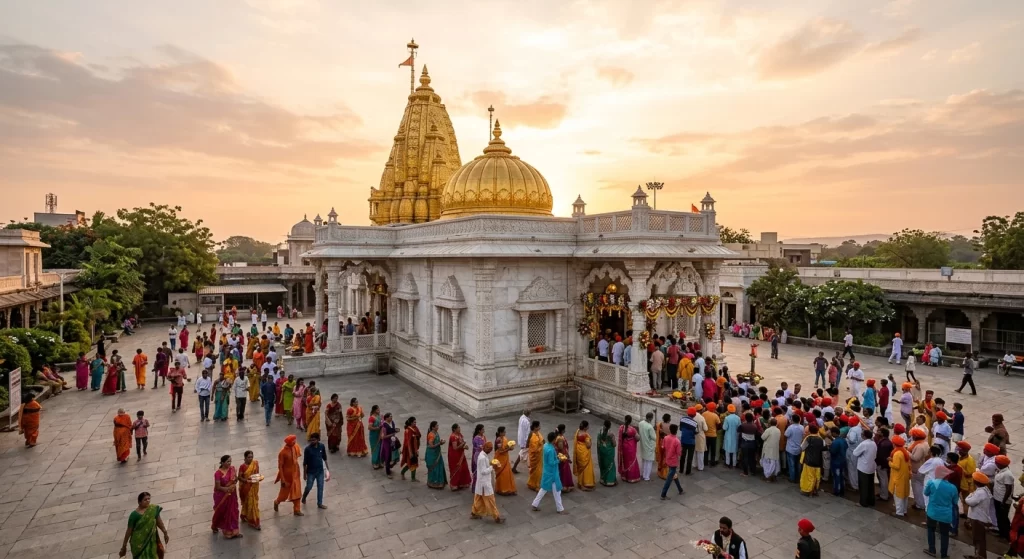
A smooth Shirdi Sai Baba darshan comes down to three things you should sort out before you leave home: when the temple rituals happen, how you will get a darshan or aarti pass, and where you will sleep. This guide covers all three, along with routes from Mumbai, Pune, Delhi and abroad, the official rates for trust-run rooms, and a simple two-day plan you can follow.
Shirdi Sai Baba Darshan at a Glance
If you only need the key facts, here they are. Timings can change on festival days and during eclipses, and the Shri Saibaba Sansthan Trust posts any changes on its official website, sai.org.in.
| What you need to know | Details |
|---|---|
| Temple opens | 4:45 AM |
| General darshan | From about 6:25 AM, after the morning rituals, until the night aarti |
| Daily aartis | Kakad 5:15 AM, Madhyan 12:00 noon, Dhoop at sunset, Shej 10:00 PM |
| General darshan fee | Free |
| Paid darshan pass | ₹200 per person |
| Official booking | online.sai.org.in or the Sansthan mobile app |
| Nearest airport | Shirdi Airport (SAG) at Kakadi, about 15 km away |
| Nearest railway station | Sainagar Shirdi (SNSI), about 3 km away |
| Trust rooms | From about ₹200 per room per day |
| Best season | October to March |
About the Shirdi Sai Baba Samadhi Mandir
Shirdi is a small town in Rahata taluka of Ahilyanagar (formerly Ahmednagar) district in Maharashtra. Sai Baba lived here for around five decades and took samadhi on Vijayadashami in 1918. The Samadhi Mandir stands over his resting place and holds the white marble idol that devotees come to see. The temple and most pilgrim services in town, including rooms, meals and passes, are run by the Shri Saibaba Sansthan Trust (SSST).
Darshan here means joining a queue that moves through a covered complex and into the Samadhi Mandir. On a quiet weekday morning it can take under an hour. On Thursdays, weekends, long weekends and festival days, the free queue can take several hours, which is why planning your timing matters more than anything else.
Shirdi Darshan and Aarti Timings
The Sansthan follows a fixed daily programme. The times below come from the trust’s published schedule.
| Time | Ritual or event |
|---|---|
| 4:45 AM | Temple opens |
| 5:00 AM | Bhupali (morning devotional song) |
| 5:15 AM | Kakad Aarti (morning aarti) |
| 5:50 AM | Mangal Snaan (holy bath) in the Samadhi Mandir |
| 6:20 AM | Aarti “Shirdi Majhe Pandharpur” |
| 6:25 AM | Darshan begins in the Samadhi Mandir |
| 11:30 AM | Dhuni Pooja in Dwarkamai |
| 12:00 noon | Madhyan Aarti (midday aarti) |
| 4:00 PM | Pothi (reading) in the Samadhi Mandir |
| Sunset | Dhoop Aarti (evening aarti) |
| 8:30 PM to 10:00 PM | Devotional songs and cultural programmes, when scheduled |
| 10:00 PM | Shej Aarti (night aarti), after which the temple closes |
Because the Dhoop Aarti follows sunset, its time moves through the year, from roughly 6:00 PM in winter to about 7:00 PM in summer. Darshan pauses while each aarti is being performed, so a queue that reaches the sanctum during an aarti will wait.
Every Thursday, and on major festivals, Sai Baba’s palkhi (palanquin) procession is taken out in the evening. It is a beautiful sight, but Thursdays are also the most crowded day of the week.
Best Time of Day for Darshan
- Early morning (6:30 AM to 9:00 AM) on weekdays usually has the shortest free queue.
- Early afternoon (1:30 PM to 4:00 PM) is often quieter, since many visitors rest after the noon aarti.
- Avoid Thursdays, Sundays, public holidays and festival days if you want a quick darshan, or buy a paid pass for those days.
Types of Darshan and Pass Costs
General darshan at Shirdi is free and open to everyone. Paid passes simply put you in a shorter, separate queue. Here is how the options compare.
| Darshan type | Cost | Good for |
|---|---|---|
| General (free) darshan | Free | Weekday visits when you have time to wait |
| Paid darshan pass | ₹200 per person | Thursdays, weekends, festivals, tight schedules |
| Kakad Aarti pass | Commonly listed at ₹600 per person | Attending the morning aarti inside the Samadhi Mandir |
| Madhyan, Dhoop or Shej Aarti pass | Commonly listed at ₹400 per person | Attending one of the other three aartis inside |
| Senior citizen and disabled darshan | Free, separate queue | Elderly devotees and visitors with disabilities |
| Live darshan | Free | Watching online through the Sansthan’s live stream |
Aarti passes are limited and sell out quickly, especially for the Kakad and Shej Aartis. Always confirm the current price on the official portal before paying, and never buy passes from touts outside the temple.
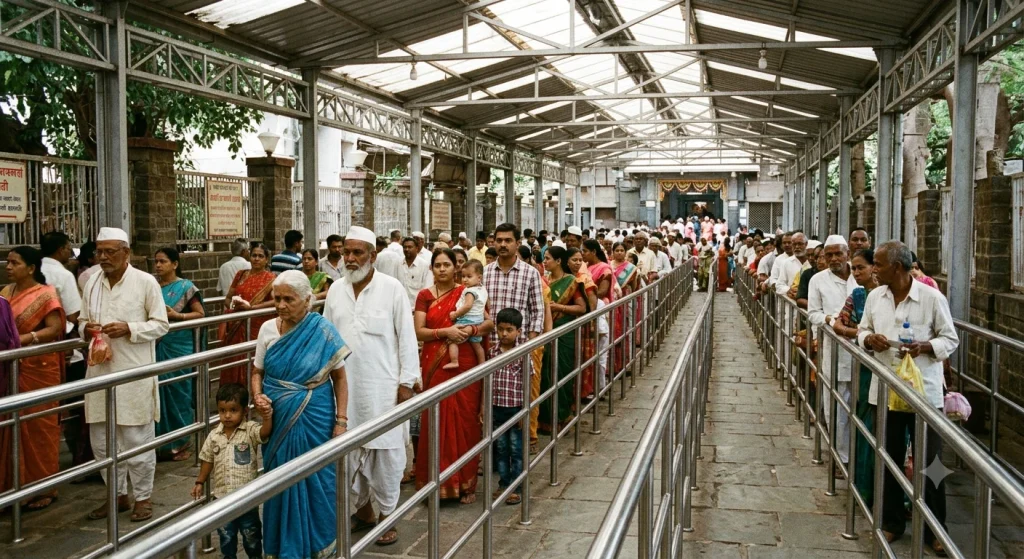
How to Book Shirdi Darshan Online
- Go to online.sai.org.in, the Sansthan’s official booking portal, or download the official Sansthan app.
- Register or log in with your mobile number (OTP) or email ID.
- Choose Darshan or Aarti, then pick your date and time slot.
- Add each devotee’s name, age and photo ID details.
- Pay online and save the e-pass on your phone or as a printout.
- Carry the same original photo ID you used while booking. You will need it at the gate.
Booking a Pass After You Reach Shirdi
If you could not book in advance, you can still get a paid darshan pass in town. The Sansthan has installed self-service paid pass kiosks near Gate No. 1, and the reception counters at trust accommodations issue paid darshan passes from 6:00 AM to 9:00 PM. Carry an ID card for everyone in your group.
How to Reach Shirdi
Shirdi sits on the Ahmednagar to Manmad highway and is well connected by air, rail and road.
By Air
Shirdi Airport (SAG) at Kakadi is about 15 km from the temple, or roughly 20 to 30 minutes by taxi. It has direct flights from several cities, including Delhi, Hyderabad, Chennai and Bengaluru, though routes change by season, so check with airlines before you plan around them. If flights to Shirdi do not suit you, Pune (about 200 km), Nashik Ozar and Chhatrapati Sambhajinagar (Aurangabad) are the next closest airports, and Mumbai has the widest choice of flights.
By Train
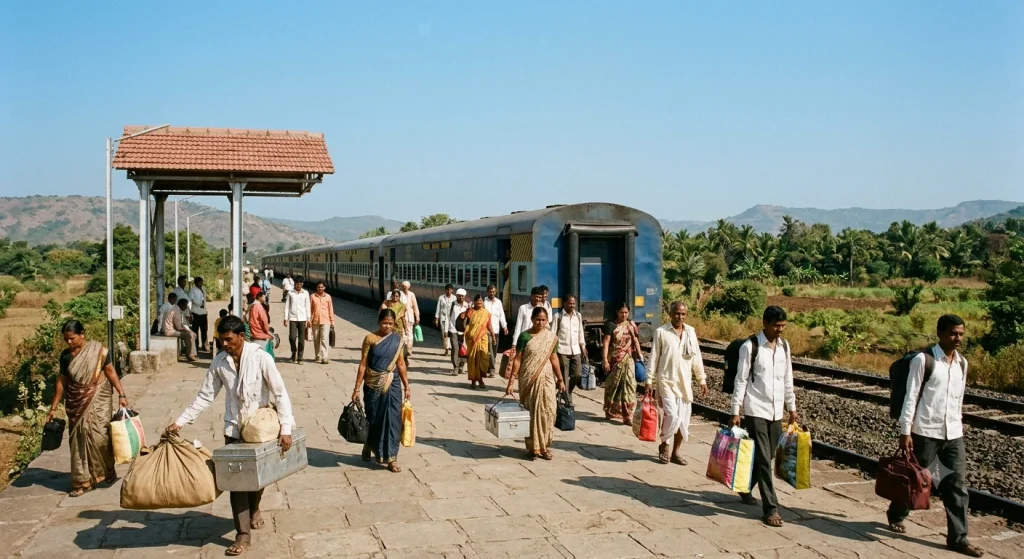
Sainagar Shirdi (SNSI) is the town’s own station, about 3 km from the temple, with trains from Mumbai, Pune, Hyderabad, Chennai and other cities. Trains from Mumbai take around 6 hours. If you cannot find a direct train, try Kopargaon (about 15 km away) or Manmad Junction (about 58 km away), which see many more trains. Autos, taxis and Sansthan buses connect the stations to the temple.
By Road
| From | Approx. distance | Approx. drive time |
|---|---|---|
| Mumbai | 240 to 250 km | 5 to 6 hours |
| Pune | 200 km | 4 to 5 hours |
| Nashik | 90 km | About 2 hours |
| Chhatrapati Sambhajinagar (Aurangabad) | 110 km | About 2.5 hours |
| Shani Shingnapur | 72 km | About 1.5 to 2 hours |
State-run MSRTC buses and private buses run to Shirdi from Mumbai, Pune, Nashik and many other cities in Maharashtra, and the Shirdi bus stand is less than half a kilometre from the temple.
From Delhi, Gurugram and Haryana
Shirdi is more than 1,200 km from Delhi by road, so flying is the practical choice. A direct flight from Delhi to Shirdi Airport saves the most time. Otherwise, fly to Pune or Mumbai and continue by road or train, or take a train towards Manmad Junction and connect to Shirdi from there.
From the USA and Other Countries
International visitors usually fly into Mumbai (BOM), then take a domestic flight to Shirdi, a train to Sainagar Shirdi, or a 5 to 6 hour taxi ride. Carry your passport at all times. Note that the trust’s room rules ask for Indian ID such as Aadhaar, PAN or a driving licence, so NRIs and foreign visitors without these should call the Sansthan helpline before booking a trust room, or book a private hotel instead.
Where to Stay in Shirdi
You have two broad choices: clean, low-cost rooms run by the Sai Sansthan, or private hotels ranging from simple lodges to premium properties. For a full list of private options, browse our Hotels in Shirdi page.
Sai Sansthan (Trust) Accommodation
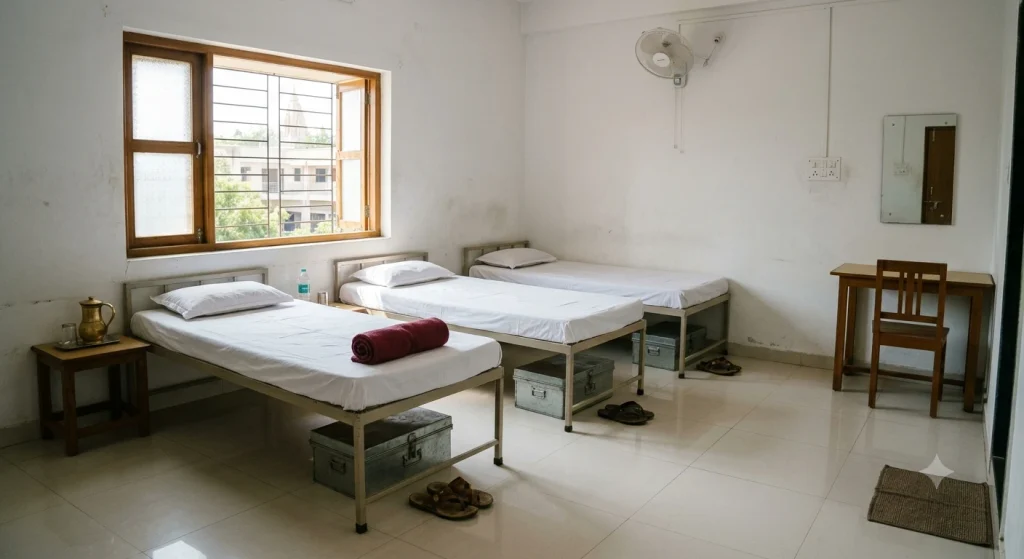
The trust runs several large guesthouse complexes, including Sai Ashram, Dwarawati and Sai Bhakta Niwas. Rates below are from the Sansthan’s official accommodation page and are per room per day.
| Accommodation | Distance from temple | Room type | Rate per day |
|---|---|---|---|
| Dwarawati | 0.5 km | AC, 3 beds, Western toilet | ₹900 |
| Dwarawati | 0.5 km | Non-AC, 3 beds | ₹500 |
| Sai Bhakta Niwas | 1.3 km | Non-AC, 3 beds | ₹200 |
| Sai Ashram Bhaktniwas | 1.7 km | AC, 3 beds | ₹600 |
| Sai Ashram Bhaktniwas | 1.7 km | Non-AC, 3 beds | ₹250 |
| Sai Niwas | 3.2 km | AC, 2 persons, Western toilet | ₹800 |
| Shanti Niketan | 100 m | Non-AC, 3 to 4 persons | ₹200 |
Most 3-bed rooms take 3 to 5 people, with floor mattresses for extra guests. You can book on online.sai.org.in under Room Accommodation, or try for a spot booking at the accommodation office in Shirdi, which is allotted first come, first served. Free shuttle buses run between the larger complexes and the temple.
Trust Room Rules to Know Before You Book
- Rooms are not given to a single person. Solo travellers can use the halls at Sai Bhakta Niwas and Sai Dharmashala.
- Couples must show valid proof of marriage. Newly married couples need a marriage registration certificate.
- Rooms are allotted for a minimum of 24 hours and a maximum of 48 hours.
- ID proof (PAN, Aadhaar or driving licence) is needed for every guest, and online bookers must bring a photocopy of their Aadhaar card.
- If you check out late, the next full day’s charge applies, and early check-outs are not refunded.
- Smoking, alcohol and tobacco are not allowed in rooms or anywhere on Sansthan premises.
Private Hotels in Shirdi
Private hotels suit solo travellers, families who want more space, and anyone who prefers hotel-style service. Most are clustered on Pimpalwadi Road and along the Nagar to Manmad highway, within walking or short auto distance of the temple. As a rough guide, budget lodges start at around ₹1,000 to ₹2,000 a night, comfortable mid-range hotels cost around ₹2,500 to ₹5,000, and premium hotels go higher. Prices jump on Thursdays, weekends and festivals, so book early for those dates.
Places to Visit in Shirdi After Darshan
- Dwarkamai: the old mosque where Sai Baba spent much of his life. The dhuni (sacred fire) he lit still burns here.
- Chavadi: the building where Sai Baba slept on alternate nights in his later years.
- Gurusthan: the spot under a neem tree where Sai Baba was first seen as a young man in Shirdi.
- Lendi Baug: a garden Sai Baba tended himself, home to the Nanda Deep, a lamp kept burning constantly.
- Khandoba Mandir: the temple where, according to tradition, Sai Baba was first welcomed with the words “Ya Sai”.
- Shani Shingnapur: the famous Shani temple about 72 km away, an easy half-day trip.
- Nashik and Trimbakeshwar: about 90 km away, with the Trimbakeshwar Jyotirlinga, often added to a Shirdi trip.
Simple 2-Day Shirdi Itinerary
Day 1: Arrival and Darshan
- Arrive, check in and leave your phone and bags in your room or at the temple’s deposit counter.
- Join the darshan queue in the early afternoon, when it is often shorter.
- Visit Dwarkamai, Chavadi and Gurusthan, all within a short walk of the Samadhi Mandir.
- Attend the Dhoop Aarti at sunset, then have dinner at the Sansthan Prasadalaya.
Day 2: Morning Aarti and Nearby Temples
- Attend the Kakad Aarti at 5:15 AM if you have a pass, or join the early darshan queue.
- Walk through Lendi Baug and visit Khandoba Mandir.
- Take a taxi to Shani Shingnapur, returning by afternoon.
- Pick up prasad and leave for home, or continue to Nashik.
Estimated Cost of a Shirdi Trip
These are rough figures to help you budget, excluding travel to Shirdi.
| Expense | Approx. cost |
|---|---|
| General darshan | Free |
| Paid darshan pass | ₹200 per person |
| Aarti pass | About ₹400 to ₹600 per person |
| Trust room | ₹200 to ₹900 per room per day |
| Private hotel | From about ₹1,000 per night |
| Meals | Free at the Prasadalaya, or about ₹150 to ₹400 per meal at restaurants |
| Local auto from station | About ₹50 to ₹150 |
| Taxi to Shani Shingnapur and back | About ₹2,000 to ₹3,000 per car |
Dress Code, Rules and Practical Tips
- Dress modestly. There is no strict dress code, but avoid shorts and sleeveless tops.
- No phones or cameras inside the Samadhi Mandir. Use the deposit counters near the gates or leave them in your room.
- Carry original photo ID for everyone, matching your online booking.
- Eat at the Prasadalaya. The Sansthan’s dining hall serves free vegetarian meals to devotees with a token.
- Ignore touts who offer quick darshan or cheap rooms. Book only through sai.org.in, online.sai.org.in or the official app.
- Wear comfortable footwear that is easy to remove, as shoes are left outside the temple.
- Keep small change for donations, lockers and autos.
Best Time to Visit Shirdi
October to March is the most comfortable time, with mild days and cool mornings. Summer (April to June) gets very hot, so plan darshan for the early morning. The monsoon months (July to September) are green and pleasant, though rain can slow road travel.
The biggest festivals are Ram Navami (March or April), Guru Purnima (July) and Vijayadashami, which marks Sai Baba’s Punyatithi (September or October). Shirdi also gets very crowded around New Year. These are special times to visit, but expect long queues, higher hotel prices and changed timings, so book rooms and passes well ahead.
Frequently Asked Questions
What are the Shirdi Sai Baba darshan timings?
The temple opens at 4:45 AM and general darshan starts at about 6:25 AM after the morning rituals. Darshan continues through the day, pausing during aartis, until the Shej Aarti at 10:00 PM. Timings can change on festival days.
Is Shirdi Sai Baba darshan free?
Yes. General darshan is free for everyone. A paid darshan pass costs ₹200 per person and gives you a shorter queue. Senior citizens and disabled visitors have a separate free queue.
How do I book Shirdi darshan online?
Book on online.sai.org.in or the official Sai Sansthan app. Register with your mobile number or email, choose darshan or aarti, select a date and slot, add ID details for each person and pay online.
How long does darshan take at Shirdi?
On a quiet weekday, darshan can take under an hour. On Thursdays, weekends and festivals, the free queue can take several hours. A paid pass usually cuts the wait a lot.
Where is the best place to stay in Shirdi?
For budget stays, Sai Sansthan rooms such as Dwarawati, Sai Bhakta Niwas and Sai Ashram start at about ₹200 a day. Solo travellers, or those who want more comfort, are better off in a private hotel near the temple.
Which is the nearest railway station to Shirdi?
Sainagar Shirdi (SNSI) is about 3 km from the temple. Kopargaon (about 15 km) and Manmad Junction (about 58 km) are good alternatives with more trains.
Are mobile phones allowed in Shirdi temple?
No. Phones and cameras are not allowed inside the Samadhi Mandir. You can leave them at the deposit counters near the gates or in your room.
What is the best day to visit Shirdi?
A weekday other than Thursday, with darshan early in the morning or early in the afternoon, usually gives the shortest wait. Thursdays are the busiest because they are considered Sai Baba’s special day.
With your darshan slot, room and travel sorted, a Shirdi trip is simple and peaceful. Check the official Sansthan website a few days before you travel for any timing changes. Planning your next getaway? Read our Goa trip cost from Delhi guide or our Munnar trip cost travel guide.